Reimagining Computer Science Curriculums for Tomorrow’s Workforce
13 August 2026
The computer science degree is at a crossroads. For decades, the standard curriculum has been a reliable pipeline into software engineering roles. But the industry has changed faster than the syllabus. Cloud computing, AI assistants, distributed systems, and product-led engineering have reshaped what employers actually need. Meanwhile, universities still lean heavily on algorithms, data structures, and a handful of elective tracks that often feel disconnected from real-world practice.
This is not an argument to tear down the fundamentals. It is an argument to rebuild the structure around them. The goal is not to produce graduates who can recite the intricacies of red-black trees from memory. The goal is to produce graduates who can reason about systems, communicate trade-offs, and adapt to tools that will be obsolete in five years. That requires a different kind of curriculum, one that treats computation as a discipline of design and judgment, not just a sequence of coding exercises.

Why the Traditional Model Is Failing
The classic computer science curriculum was designed in the 1970s and 1980s, when computing was a niche discipline. The focus was on mathematical foundations, compiler theory, and operating systems. That made sense when most graduates went on to build compilers, kernels, or database engines. But today, the majority of CS graduates work on web applications, mobile apps, data pipelines, and internal tooling. They use frameworks that abstract away memory management. They deploy to cloud platforms that handle scaling automatically. They collaborate in teams where the hardest problems are often about requirements, not recursion.The mismatch creates a few predictable problems. First, students graduate with strong theoretical knowledge but weak practical judgment. They can implement a hash table from scratch but struggle to choose between a relational database and a document store for a specific use case. Second, the curriculum is too slow to respond to industry shifts. By the time a new course on machine learning or distributed systems is approved and staffed, the field has moved on. Third, the emphasis on individual achievement ignores the reality that software is built in teams. Pair programming, code review, and incident response are rarely taught as first-class skills.
None of this means the fundamentals are useless. It means they need to be recontextualized. A student who understands complexity analysis but has never profiled a slow query is not prepared for production work. A student who can prove the correctness of a sorting algorithm but cannot write a clear design document is not prepared to lead a project. The curriculum needs to bridge that gap deliberately, not leave it to internships and luck.

The Core Skills That Matter More Than Ever
Before redesigning a curriculum, it helps to identify what actually matters in the modern workforce. Based on how hiring has evolved over the past decade, a few skills stand out as consistently undervalued in academic settings.Systems Thinking Over Algorithm Memorization
Algorithm design is still important, but the emphasis has shifted. Most professional developers do not invent new algorithms. They compose existing ones, often through libraries and frameworks. What they do need is the ability to reason about systems: how data flows, where bottlenecks appear, what happens when a service fails, and how to design for resilience. A course on distributed systems used to be an advanced elective. Now it should be a core requirement, even if it is taught at a conceptual level.The key is to teach systems thinking through concrete scenarios. Instead of a purely theoretical lecture on consensus protocols, have students simulate a multi-node database and observe what happens when one node goes down. Let them feel the pain of eventual consistency. Let them debug a race condition in a concurrent program. These experiences build intuition that no amount of textbook reading can provide.
Data Literacy as a Default Skill
Every software product today is data-driven, whether it is a recommendation engine, a dashboard, or a simple logging system. Graduates need to be comfortable with data modeling, querying, and basic statistical reasoning. This does not mean every student must become a data scientist. It means they should know how to structure data for efficient access, how to write a non-trivial SQL query, and how to interpret metrics without falling for common fallacies.A common mistake in many programs is treating databases as an optional elective. That is a serious error. Database design is not a niche topic. It is the backbone of almost every application. A student who cannot normalize a schema or explain the difference between an index and a full table scan will struggle in any backend role. This should be taught early, alongside programming fundamentals, not as an afterthought.
Communication and Collaboration as Engineering Skills
The stereotype of the lone programmer in a dark room is outdated. Modern software development is a team sport. Engineers write design docs, give code reviews, present technical proposals, and collaborate with product managers and designers. These are not soft skills. They are engineering skills that require practice and feedback.Curriculums should include required courses or modules on technical communication. That means writing clear documentation, giving effective presentations, and conducting respectful but rigorous code reviews. It also means learning how to give and receive criticism without ego. Many students enter the workforce with zero experience in these areas, and it shows. They either stay silent in meetings or dominate them. Neither is useful.

A Proposed Framework for a Modern Curriculum
There is no single perfect curriculum, but there is a sensible structure that balances depth, breadth, and adaptability. The following framework is not a rigid prescription. It is a starting point for departments that want to produce graduates who can thrive in the next decade.Year One: Foundations with Immediate Application
The first year should establish programming proficiency and computational thinking, but it should do so with real-world context. Instead of abstract exercises like calculating Fibonacci sequences, students should build small but complete applications: a personal finance tracker, a simple chat client, a quiz game with persistent storage. The goal is to show that code produces tangible outcomes.In parallel, students should take a course on data and information. This covers basic data types, file formats, and an introduction to relational databases. By the end of the first year, students should be able to build a simple CRUD application with a database backend. That is a realistic and motivating goal.
Year Two: Systems and Abstraction
The second year introduces the core systems concepts: operating systems, networking, and concurrency. But these should be taught with a practical slant. For example, an operating systems course can include a project where students build a mini-shell or a simple scheduler. A networking course can have students implement a basic HTTP server and then analyze its performance under load.This is also the time to introduce software engineering practices. Version control, testing, and debugging should be taught explicitly, not assumed. Students should work in pairs or small teams on a semester-long project. The project should have a real user, even if that user is another class or a local nonprofit. That forces students to deal with requirements, scope, and feedback.
Year Three: Depth and Specialization
By the third year, students should have enough foundation to choose a specialization. Common tracks include machine learning, security, distributed systems, human-computer interaction, and graphics. But specialization should not mean isolation. A machine learning student still needs to understand how to deploy a model as a service. A security student needs to understand how to build a secure API. The curriculum should require cross-disciplinary projects.This is also the year to introduce ethics and societal impact. Not as a standalone lecture, but as a recurring theme. Students should discuss real case studies: algorithmic bias, privacy violations, and the unintended consequences of automation. They should be asked to write position papers and defend their reasoning. This is not about making students activists. It is about making them aware that their code has consequences.
Year Four: Integration and Capstone
The final year should be about integration. A capstone project is essential, but it should not be a solo exercise. Students should work in teams of four to six, with a real client, a real problem, and a real deadline. The project should span multiple domains: frontend, backend, database, and deployment. Students should be responsible for project management, documentation, and delivery.In addition, the fourth year should include a course on modern software delivery. This covers continuous integration, containerization, cloud deployment, and monitoring. These are the tools that professionals use every day, yet they are rarely taught in academic settings. A student who has never used Docker or deployed to a cloud provider is at a significant disadvantage in the job market.
The Role of AI and Automation in the Curriculum
Artificial intelligence is not just another topic to add to the syllabus. It is a force that changes how all other topics should be taught. Code assistants like GitHub Copilot and ChatGPT can generate boilerplate, suggest implementations, and even explain errors. This is both an opportunity and a threat.The opportunity is that students can move faster and focus on higher-level design. The threat is that they will rely on generated code without understanding it. The curriculum must address this head-on. Students should be taught how to use AI tools effectively, but also how to verify their output. That means writing tests, reading generated code critically, and understanding the underlying algorithms well enough to catch subtle bugs.
A practical approach is to allow AI tools in lower-level courses but ban them in exams and certain assignments. In advanced courses, students should be required to document their use of AI and explain why they accepted or rejected specific suggestions. This builds a habit of critical engagement rather than blind acceptance.
Common Mistakes and Misconceptions
Several recurring mistakes plague curriculum redesign efforts. One is the belief that adding more courses is the solution. The problem is often not the number of courses but their content and sequencing. Adding a course on blockchain or quantum computing without fixing the core is like adding a new wing to a house with a cracked foundation.Another mistake is treating industry feedback as a wish list. Companies often ask for more experience with specific tools like React or Kubernetes. But tools change quickly, and a curriculum built around today's tools will be obsolete in five years. The better approach is to teach underlying concepts and then map them to current tools. A student who understands component-based UI architecture can learn React in a week. A student who only knows React will struggle when the next framework arrives.
A third misconception is that online courses or bootcamps can replace a degree. They cannot. Bootcamps are excellent for rapid skill acquisition, but they lack the depth and breadth of a university education. The goal is not to compete with bootcamps. It is to offer something they cannot: a rigorous foundation, a broad perspective, and the ability to learn new things independently.
Trade-offs and Balanced Viewpoints
There is a real tension between depth and breadth. A curriculum that tries to cover everything will produce graduates who know a little about a lot but nothing deeply. A curriculum that focuses too narrowly will produce graduates who are excellent in one area but unable to adapt. The resolution is not to choose one extreme but to design a spiral curriculum where key concepts are revisited at increasing levels of complexity.Another trade-off is between theory and practice. Too much theory leaves students unprepared for the messiness of real systems. Too much practice leaves them without the conceptual tools to reason about new problems. The best approach is to interleave them. Teach a concept, then immediately apply it in a project. When the project fails, go back to the theory to understand why. This cycle of action and reflection is how professionals actually learn.
There is also the question of whether to require internships. Some argue that internships are essential for job placement. Others argue that they disrupt academic continuity and favor students with connections. A middle ground is to make internships optional but to provide strong support for students who pursue them. This could include credit for structured internships, partnerships with local companies, and reflection assignments that connect work experience to academic concepts.
Practical Advice for Implementation
For departments that want to redesign their curriculum, start small. Do not try to overhaul everything at once. Pick one or two courses and pilot new approaches. Measure the results. Talk to students and alumni. Adjust based on feedback.Involve industry practitioners in the design process, but do not let them dictate the curriculum. A good advisory board can provide valuable input on emerging trends and skill gaps. But the final decisions should be made by educators who understand pedagogy and long-term goals.
Invest in faculty development. Many professors were trained in traditional computer science and may not be comfortable with modern tools or teaching methods. Provide workshops, release time, and incentives for faculty to learn new skills and experiment with new approaches.
Finally, be honest about what you cannot do. No curriculum can guarantee a job or prepare students for every possible career path. The goal is to produce adaptable, thoughtful, and skilled graduates who can navigate uncertainty. That is a more realistic and more valuable outcome than trying to predict the future.
The Path Forward
Reimagining computer science education is not a one-time project. It is an ongoing process of adaptation. The technology will keep changing, and the curriculum must change with it. But the underlying principles remain stable: teach fundamentals deeply, connect them to practice, develop communication and collaboration skills, and foster a mindset of lifelong learning.The students entering college today will work for forty or fifty years. Many of the jobs they will hold do not exist yet. The best thing a curriculum can do is give them the tools to learn, unlearn, and relearn. That means focusing on concepts over tools, judgment over memorization, and people over code.
The future of the workforce depends on graduates who can do more than write code. They must be able to ask the right questions, evaluate trade-offs, and build systems that serve real human needs. A curriculum that embraces that vision will not just produce better engineers. It will produce better thinkers, better collaborators, and better leaders.
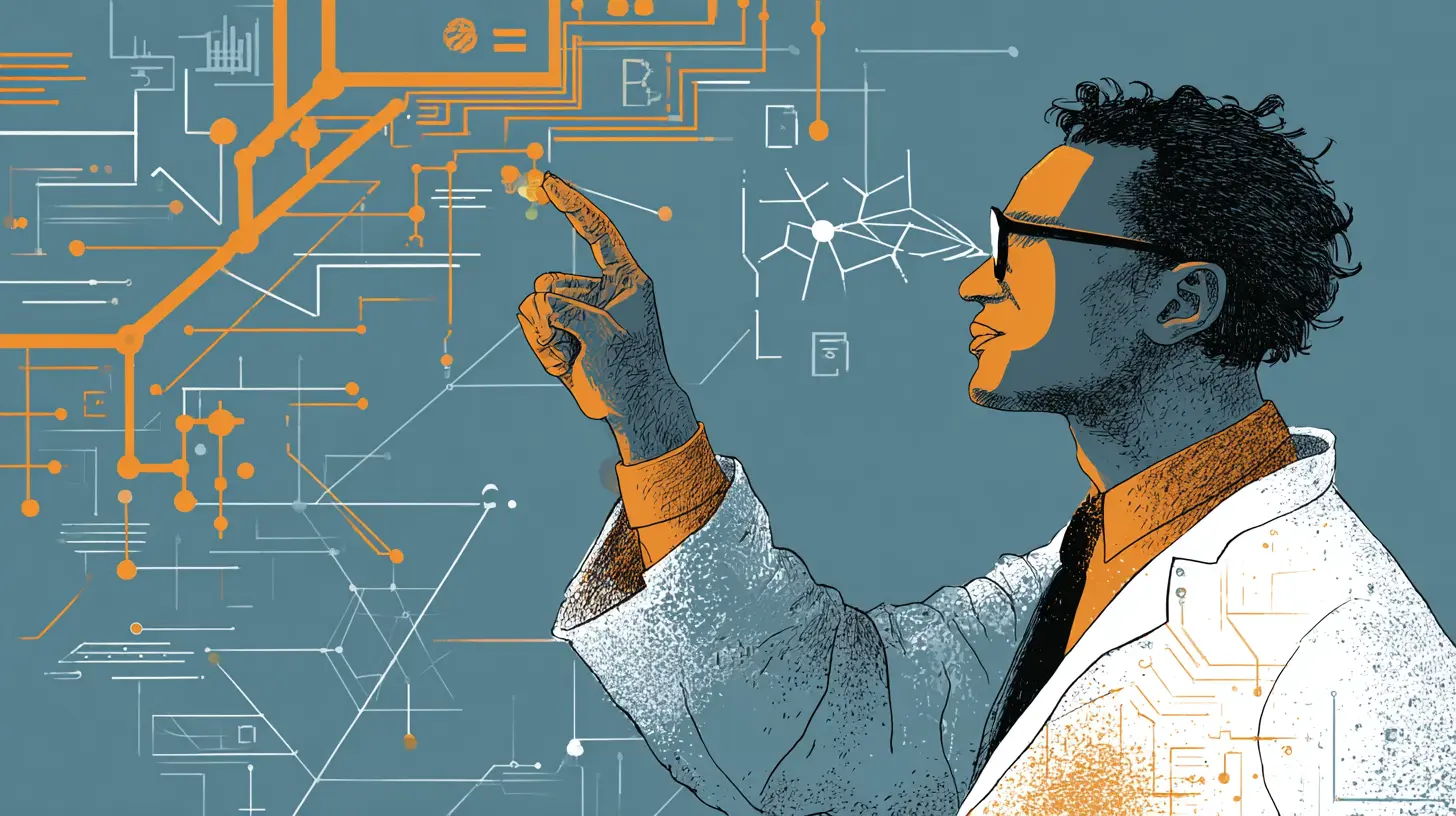
all images in this post were generated using AI tools
Category:
Tech EducationAuthor:

Vincent Hubbard